

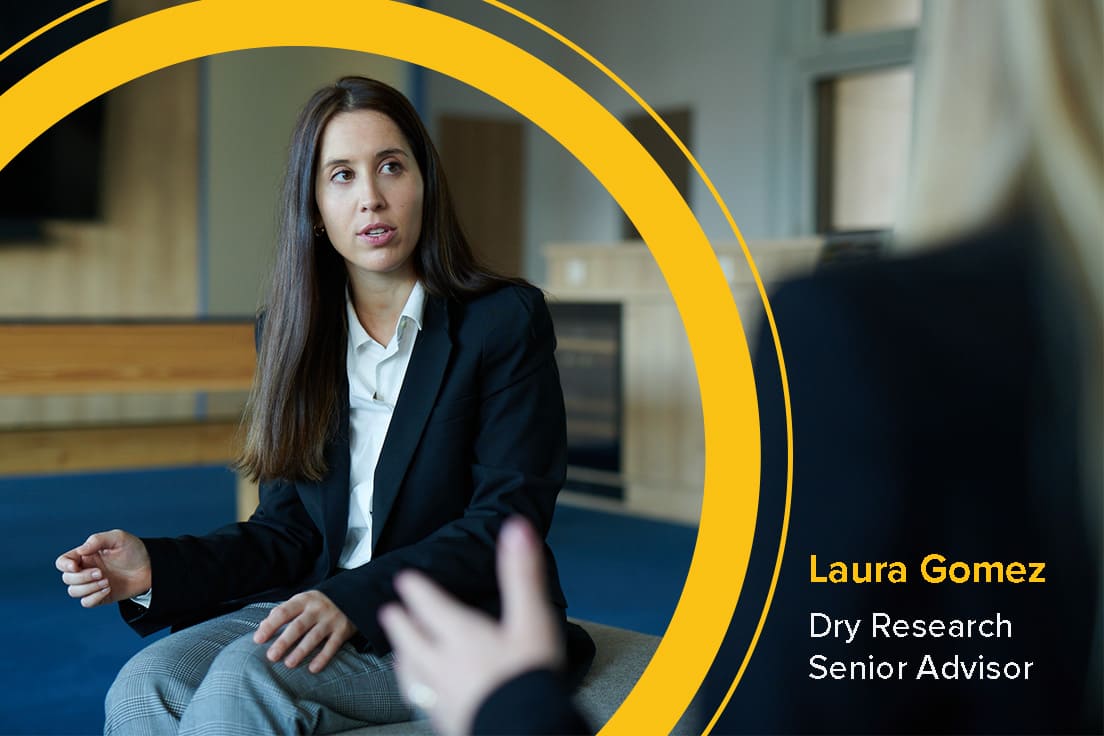
Based in Geneva, Laura Gomez is one of the 12-strong team behind IFCHOR GALBRAITHS’ shipping market research offering. A dry bulk analyst, she is the author of the firm’s annual Iron Ore 360 report, a product built to give clients a granular, mine-level understanding of one of shipping’s most important commodities.
It is detail-heavy work and the kind that requires scrutiny, patience and an appetite for complexity.
“Not everyone is as strict with data as we are,” Laura Gomez says. “For our iron ore report for example we check every project down to the mine level, even what locomotives are being used. At first, I thought this was a bit forensic, but now I understand its value.”
That attention to detail has become increasingly important in a market where there is no single source of truth when it comes to global iron ore production and interpreting the signals is key.
From mining engineering to market intelligence
Laura’s route into dry bulk research for a shipbroking company was unusual.
Originally from Galicia in northwest Spain, she studied mining engineering at the University of Vigo between 2009 and 2014. Here she gained a rounded view of how to locate, extract and process minerals such as coal and iron ore, along with a grounding in processes like steelmaking and producing aluminium from bauxite. Her studies spanned everything from tunnel digging and bridge construction to mine planning and economics. In the latter years of her degree, she specialised in materials science, focusing on the development of new materials for industrial applications.
Her first professional role was in a university lab, followed by a position as a quality control engineer at a paint factory. She then moved to Madrid to work as an oil analyst on the trading desk at energy major Repsol. Later, she relocated to Switzerland to work at CERN, the world’s largest particle physics laboratory and home to the Large Hadron Collider.
Engineering offered challenge and technical complexity, but Laura found herself drawn more naturally to analysis.
“I wanted to see whether engineering was for me,” she says. “But I realised I preferred the fast-paced and exciting world of being an analyst.”
She joined IFCHOR in September 2017, initially supporting tanker research at a time prior to the firm’s merger with tanker specialist GALBRAITHS. But the company’s research priorities evolved, and so did Laura.
Dry bulk soon became her focus — along with a steep learning curve.
“There was so much to learn,” she says. “The endless list of dry bulk commodities, the supply story, demand, the different trades…”
Yet even after nearly a decade in the industry, she still describes herself as learning.
“Every year, I’m learning something new,” Laura says. “The first years were about understanding the intricacies of the dry bulk market. Then it became about data science: learning Python and coding. Now, it’s about mastering AI.”
Why good research still matters in the AI era
She laughs when referencing the familiar refrain that ‘AI can do any job’.
In Laura’s world, the reality is rather different.
AI has become a valuable tool inside research teams. It helps IG summarise legislation impacting the markets, interrogate in-house databases and speed up routine analysis. Laura Gomez already uses it to ask questions about shifts in commodity supply chains or to synthesise regulatory developments that could affect exports.
She comments: “If Indonesian coal exports are falling, what capacity do other countries have to substitute it?”
AI helps her work through scenarios, but she is the one who knows where to look and how to weigh the answer against the latest market news.
However speed, she argues, should not be confused with expertise.
“The downside of AI is that everyone thinks they can do dry bulk research quickly on their own,” Laura says. “But AI doesn’t have the same critical eye as we do. Does AI understand the source and accuracy of the underlying data? What are its assumptions?”
Every day, she says, she finds herself challenging conclusions produced by AI.
“I find I’m often telling AI, ‘you’re wrong.’ Then it says, ‘yes, you’re right!’”
That human oversight matters in dry bulk shipping, where market fundamentals can shift rapidly and small details can have outsized consequences.
“This is a fast-changing world, and what’s true today can be wrong tomorrow,” she clarifies. “But we have something AI doesn’t: memory and the experience of years in shipping.”
The work behind Iron Ore 360
Those principles sit at the heart of Iron Ore 360, Laura Gomez’s flagship research product.
The report is designed to provide a deeper understanding of iron ore flows and production fundamentals, combining detailed mine-level intelligence with freight market context to help clients navigate a highly consequential commodity market.
Laura Gomez and the wider research team interrogate supply chains in detail — from infrastructure and transport logistics to operational developments that could materially alter trade flows. She looks in detail at projects coming on stream, company reports, AIS data, mining news and intelligence from across the IG network.
It is the kind of research that rewards precision.
“Brokers are often ahead of the news,” Laura explains. “Congestion at a port because of bad weather, a shift in sentiment, something a client has seen on the ground: there’s a lot happening before it becomes public information.”
That close dialogue with brokers, clients and the wider market give the research team what Laura Gomez describes as an essential advantage: context.
“Clients and colleagues often hear about things first, telling us what’s happening in the ports and terminals around the world. We also have very strong relationships on the newbuilding side and the broadest possible view of what has been ordered at each shipyard,” she says.
For Laura, the real test of research is foresight: not describing today’s market, but giving clients the confidence to position for tomorrow’s.
No typical day
Ask Laura what a normal day looks like, and she smiles.
“There isn’t one, and honestly that’s part of the fun,” she says.
Some weeks are spent producing regular dry bulk market updates. Others are dominated by bespoke projects, client presentations or highly specific, deep-dive data projects.
At the time of writing, her attention is on a focus report on Indonesian coal, alongside refining vessel orderbook information.
It is analytical work that often happens behind the scenes, but underpins the confidence clients place in forecasts and market intelligence.
For Laura Gomez, that process — in equal parts technical, investigative and instinctive — remains deeply rewarding.
Because in shipping research, confidence that your datasets are robust enough to back up your forecasts is vital.