

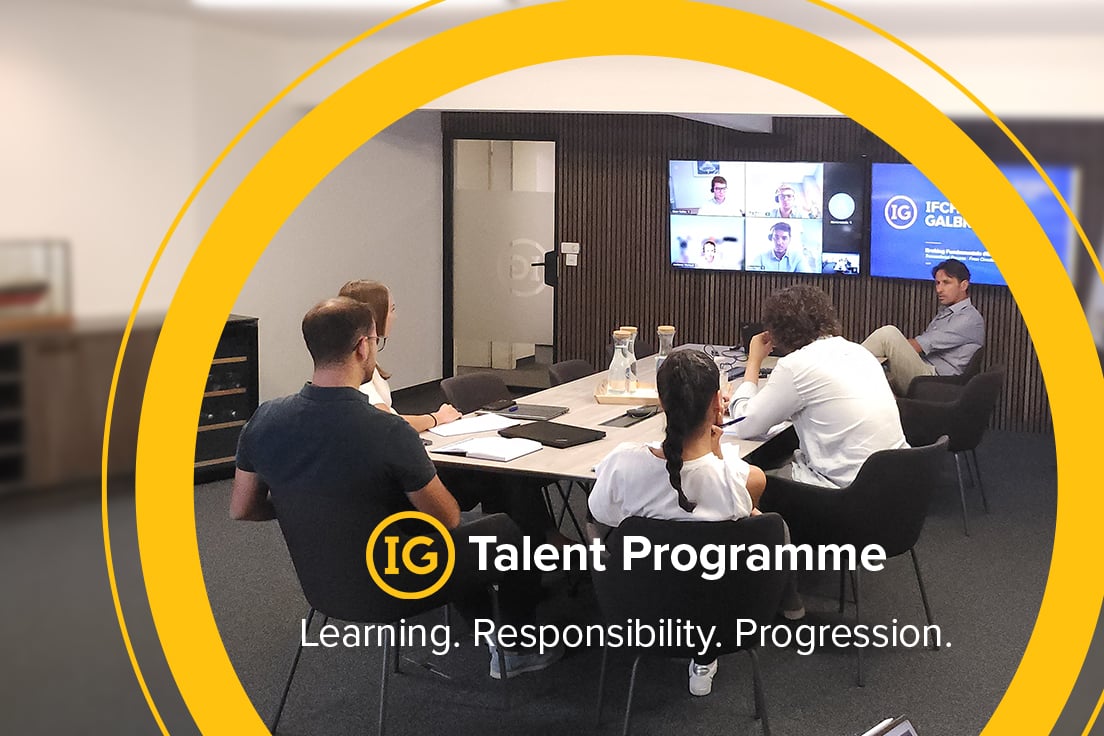
There is no single background that defines a future shipbroker or shipping professional.
At IG, our 12 month talent programme is built to take a new entrant on a development journey and start their career in shipping. By gaining exposure to live markets, building networks, developing commercial and negotiation skills, IG trainees are given a unique opportunity to grow with a leading international shipbroker with a very special culture.
What that looks like in practice is best explained through the people who have lived it.
Ryan Inayat and Rebecca Guetta joined IG through very different routes. Today, they are both key contributors — one in tanker research in London and the other on the geared dry bulk broking desk in Lausanne. Their stories show how the same trainee scheme can support different personalities, skills, and ambitions.
Ryan Inayat: From Curiosity to Commercial Insight

Ryan first came to IG through a short research internship while studying geography at university. Like many people new to shipping, he quickly realised how complicated the industry really is. Complicated because you are learning about the world’s ports and terminals, the technical specifications of a fleet of specialised vessels, constantly shifting trade flows, and an entirely new language — all at the same time.
“The limits of your shipping specific geographical knowledge, particularly lesser-known ports and terminals, are revealed when you start working in shipping,” he says. “The amount of geopolitics and global knowledge involved is huge.”
Following the internship, Ryan joined the IG Talent Programme (IGTP) and transitioned into a full-time role in tanker research. His learning curve was steep — but structured.
From the start, Ryan was exposed to multiple parts of the business: brokers, desks, data platforms, and global colleagues. Rather than learning in isolation, he learned through constant interaction.
“What surprised me most was how much time people had for me,” he explains. “Whether it was my manager or heads of department, everyone was willing to explain things properly — even going back to the fundamentals.”
Good researchers do more than simply produce information. Ryan learned how to synthesise multiple data sources, interpret trends, and communicate what actually matters — skills that are becoming increasingly important as AI accelerates access to raw data.
Today, Ryan works at the centre of the tanker market flow: collecting data, analysing rates, tracking geopolitical developments, supporting brokers, and contributing to client reports and presentations. His role requires both technical precision and commercial awareness — skills developed steadily through the talent programme.
“There’s always more to know,” he says. “But here, you’re given the chance to learn properly — and to keep learning.”
Rebecca Guetta: From Learning the Language to Fixing Ships

Rebecca’s route into shipping was very different.
She grew up around the industry, but her formal education was in hospitality. Before joining IG, she completed internships in hospitality and at Nestlé — with no direct shipping experience.
“When I started, the first thing to learn was the vocabulary,” she says. “It’s like learning a new language. If you don’t understand it, you can’t read emails or quotes.”
Her trainee journey was deliberately hands-on. She spent time in operations, learning how voyages unfold in reality and how problems arise — and how brokers anticipate them. Only after that did she move onto the broking desk.
“That made everything much easier,” she explains. “When you arrive on the desk, you already understand what you’re talking about.”
Now a junior broker on the geared desk in Lausanne, Rebecca fixes deals both independently and alongside senior colleagues. She has her own clients and growing responsibility — something she values highly.
“After two years, I’m almost fully independent,” she says. “There’s real space here for young people to grow and take ownership.”
Her first fixture was a milestone — not because she understood everything, but because she felt supported.
“Your colleagues are your first clients,” she says. “Most first fixtures happen because someone helps you. That’s how you learn.”
One Scheme, Many Outcomes
Ryan and Rebecca’s experiences highlights how the IG Talent Programme does not just produce one type of professional.
It provides:
- A structured introduction to the industry
- Exposure to different desks and functions
- Mentorship from experienced colleagues
- Trust, responsibility, and progression based on the individual
Digital skills and technology training, including market platforms and data tools are also a critical part of the programme.
AI means certain aspects of broking are becoming faster, more efficient, and increasingly standardised — but that does not reduce the importance of people. AI changes how data is processed and presented, it raises the bar for what IG is looking for and changes what “great talent” looks like. IG hires on the basis of how candidates think, adapt, and apply their judgement.
Independence does not come on a fixed timeline. Some people are ready sooner, others take longer.
“Everyone is different,” Rebecca says. “It depends on your experience, your personality, and how you build relationships.”
What unites trainees is the special and highly supportive culture around them.
Shipping is demanding and shipbroking even more so. Pressure cannot be fully explained — it has to be experienced. The trainee scheme doesn’t remove that reality, but it does ensure people are not facing it alone.
“There’s a real sense that everyone benefits from helping each other,” Ryan adds. “It feels like a well-oiled machine — but one where people actually care.”