

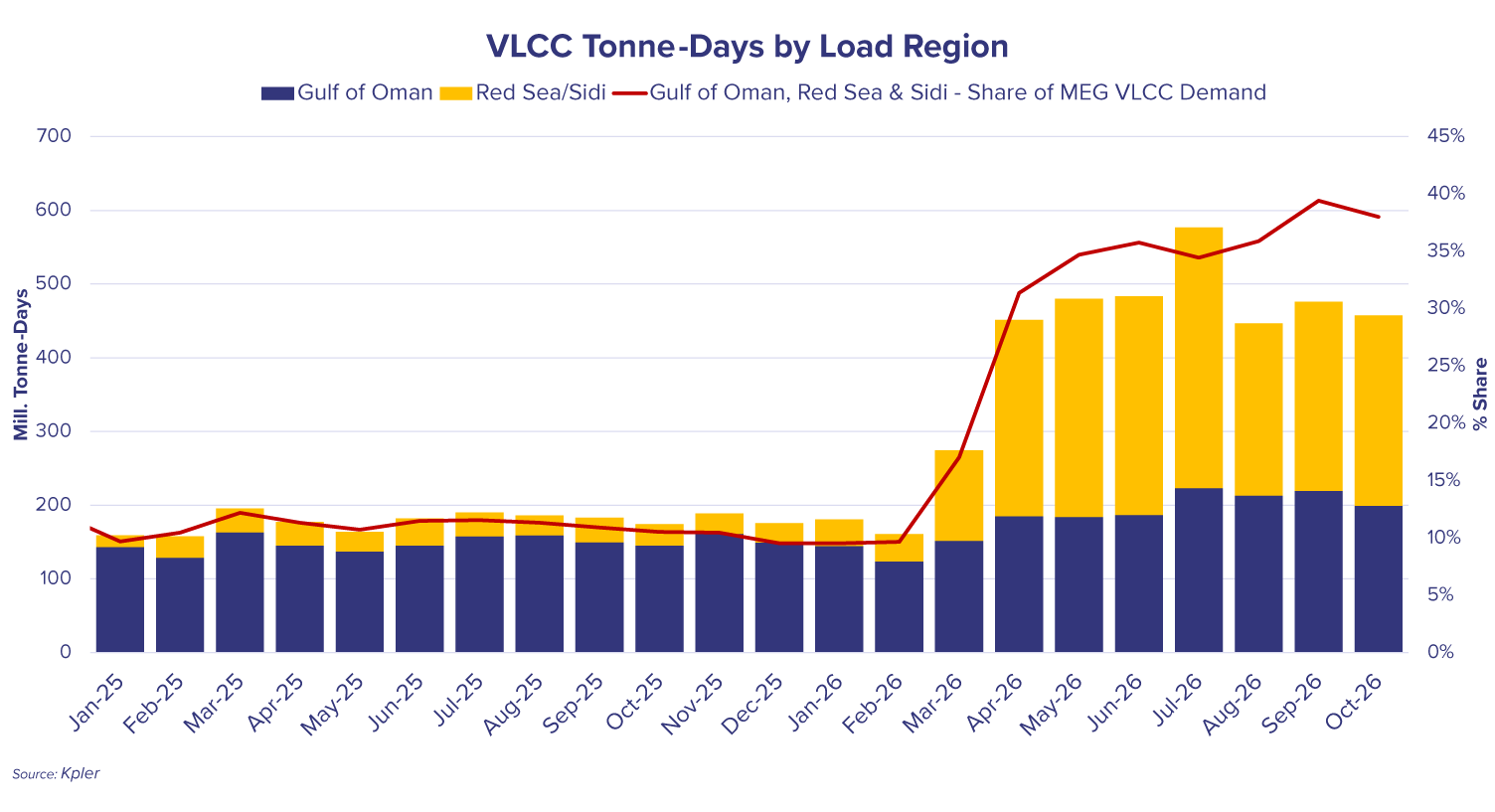
As the conflict in the Middle East enters its ninth month, market participants have adapted to a ‘new normal’ characterised by uncertainty, volatility and inefficiencies. The rerouting of export barrels through alternative loading regions has played a crucial role in maintaining the flow of crude to international markets. Despite the emergence of a sizeable Hormuz ‘shuttle’ fleet, terminals at Fujairah, Yanbu and Sidi Kerir continue to play a significant role in facilitating regional exports, providing vital alternatives to traditional loading locations and generating substantial tanker demand.
With conflicting signals emerging from US–Iran negotiations, inconsistent messaging from the US administration, especially post-midterms and continued attacks on regional infrastructure and commercial shipping, energy security looks set to remain a defining theme for global oil markets over the coming months and potentially years.
While Middle Eastern producers were quick to adapt their export operations to the ‘new normal’, attention has increasingly turned towards longer-term infrastructure solutions aimed at reducing exposure to the Strait of Hormuz. Among the most significant developments is the UAE’s accelerated timetable for the West-East pipeline project, which could have far-reaching implications for regional crude flows and tanker demand.
Recent reports suggest that the UAE has been offering long-term customers the opportunity to load additional volumes in early 2027, including offshore grades that cannot currently access Fujairah via the existing pipeline. The existing ADCOP pipeline has a nominal capacity of approximately 1.5m b/d, with throughput reportedly reaching 1.8m b/d. Once fully operational, the new West–East project is expected to roughly double the UAE’s combined export capacity through Fujairah. In theory, the pipelines would have sufficient capacity to accommodate a far greater share of the UAE’s crude production, allowing export barrels to bypass the Strait of Hormuz in greater quantities.
For the tanker market, the implications could be notable. By shifting a greater proportion of UAE exports directly to Fujairah, the new pipeline would reduce the need for costly, inefficient and potentially dangerous shuttling operations through the Strait. While this would improve export efficiency and security of supply, it could also remove a source of incremental tanker demand that has emerged during the conflict.
In the 2H2026, the UAE is estimated to have exported an average of just under 900,000b/d via the Hormuz shuttles, although some poor visibility may result in actual volumes sitting slightly higher. The planned pipeline is expected to have enough capacity to absorb these volumes in their entirety. Loading these barrels directly at Fujairah would not only marginally shorten the onward voyage but also eliminate the additional shuttle leg and associated delays from Strait transits and STS operations. Crucially, however, the underlying long-haul trade to end consumers would remain, limiting the impact on overall seaborne crude demand.
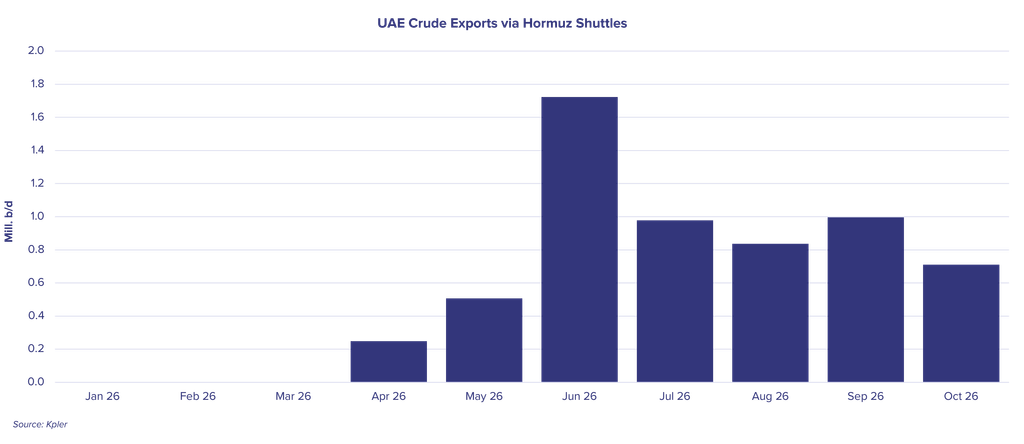
However, the wider Hormuz shuttle trade is unlikely to disappear. Many other MEG exporters remain heavily dependent on the Strait, with limited alternative export infrastructure. Provided the current geopolitical environment persists, shuttle operations are therefore likely to remain an important feature of regional tanker markets.
It is also important to note, that the pipeline expansion project sits as part of a broader tranche of policies for the UAE. Their departure from OPEC earlier this year was seen as a clear signal of intent to increase production levels, with the IEA forecasting an average of 5.18m b/d across 2027 (up from 4.53m b/d this year), and the Energy Minister suggesting production could hit as much as 6m b/d, if “market conditions require”. While these production figures do not translate directly into equivalent increases in crude exports, they nevertheless point to the potential for additional seaborne volumes, which could offset some of the tanker demand lost as shuttle operations decline.
The UAE is by no means the only country exploring infrastructure projects in the region. Saudi Arabia is reportedly considering further expansion to the existing East-West pipeline and is exploring the feasibility of a pipeline terminating in Duqm.
More broadly, the expansion highlights how the infrastructure investments designed to strengthen energy security could ultimately impact some of the tanker demand created by the conflict, with potentially lasting consequences for vessel utilisation and regional trade patterns.